










COVERCHORD FEATURE
KUTAMI SHIBU UCHIWA BY KURIKAWA SHOTEN
TRADITION BRINGING COOLNESS & GOOD FORTUNE
Both a practical tool and a beautiful interior accent.
A traditional uchiwa crafted in Kutami, Kumamoto with over 130 years of history.

Recognized alongside Kyoto and Marugame as one of Japan’s three major uchiwa styles, KUTAMI SHIBU UCHIWA is a traditional craft from Yamaga City in Kumamoto Prefecture.
Founded in 1889, KURIKAWA SHOTEN is now the only remaining workshop in Japan dedicated to the making of KUTAMI SHIBU UCHIWA.
Each piece is carefully handcrafted by artisans, resulting in more than just a tool―it is an object steeped in history and craftsmanship.
Characterized by a shape that efficiently catches the wind, it creates a cooling breeze with just a light movement.
Made from madake bamboo and washi paper, the surface is coated with kakishibu (fermented persimmon tannin), which not only strengthens the paper but also offers natural insect-repellent properties. Over time, the soft brown hue deepens into a rich, refined color.
These uchiwa are not only used to stay cool, but also as practical tools in the kitchen or as decorative interior pieces thanks to their elegant form.
With “Kutami” meaning “the people come,” they are also considered auspicious items that bring prosperity, making them ideal as thoughtful gifts.
COVERCHORD visited the KURIKAWA SHOTEN workshop in Yamaga to explore how these KUTAMI SHIBU UCHIWA are made.
KUTAMI SHIBU UCHIWA, Japanese Traditional Craft


The history of KUTAMI SHIBU UCHIWA dates back to 1600.
Legend has it that a traveling monk from Marugame, Kagawa, shared the uchiwa-making technique as a token of gratitude for a night’s lodging.
The region of Yamaga, Kumamoto―home to Kutami―was historically known for its kozo (paper mulberry) cultivation and traditional washi paper production. The surrounding forests of the Aso mountain range also provided an abundance of madake bamboo, ideal for crafting uchiwa frames.
With these local resources, Kutami became an ideal environment for uchiwa making.
The craft took root in the community and flourished under the patronage of the Hosokawa clan of the Higo Kumamoto Domain during the Edo period. By the early Showa era, uchiwa production reached its peak, with 35 workshops in Yamaga producing as many as 6 million uchiwa annually.
KUTAMI SHIBU UCHIWA is made through five main processes, the final and most defining being the application of fermented persimmon tannin, known as shibu-nuri.
Extracted from unripe gara-gaki persimmons, this natural coating adds insect-repelling, anti-mold, and waterproofing properties―enhancing both durability and longevity.
Over time, the pale brown color of the coating deepens, developing a rich patina unique to this traditional uchiwa making process.
From Selling Objects to Sharing the Heart
KURIKAWA SHOTEN
Since its founding in 1889, KURIKAWA SHOTEN has been producing and selling KUTAMI SHIBU UCHIWA for over 130 years. Today, it remains the only workshop in Japan that continues to craft these traditional uchiwa.
When the previous head, Ryoichi Kurikawa, took over the family business in 1991, mass-produced plastic uchiwa for advertising had already become the mainstream.
As a result, demand for traditional uchiwa had sharply declined, and techniques once taken for granted were beginning to fade with the times.
Recognizing the quiet beauty and handmade texture of KUTAMI SHIBU UCHIWA, Kurikawa saw new potential in their value as commemorative or personalized gifts.
By preserving traditional methods while expanding their use, he opened a new path forward for the craft.
Rooted in the skills and spirit passed down by his predecessor, KURIKAWA SHOTEN’s KUTAMI SHIBU UCHIWA evolved into a refined everyday item that resonates with modern lifestyles.
Today, the workshop produces around 30,000 uchiwa per year.
Now led by fifth-generation head Kyohei Kurikawa, the workshop continues to pass on its long history. Guided by the words of his predecessor―“from selling objects to sharing the heart”―he continues to create each uchiwa with care and deliver this traditional craft to people in Japan and beyond.
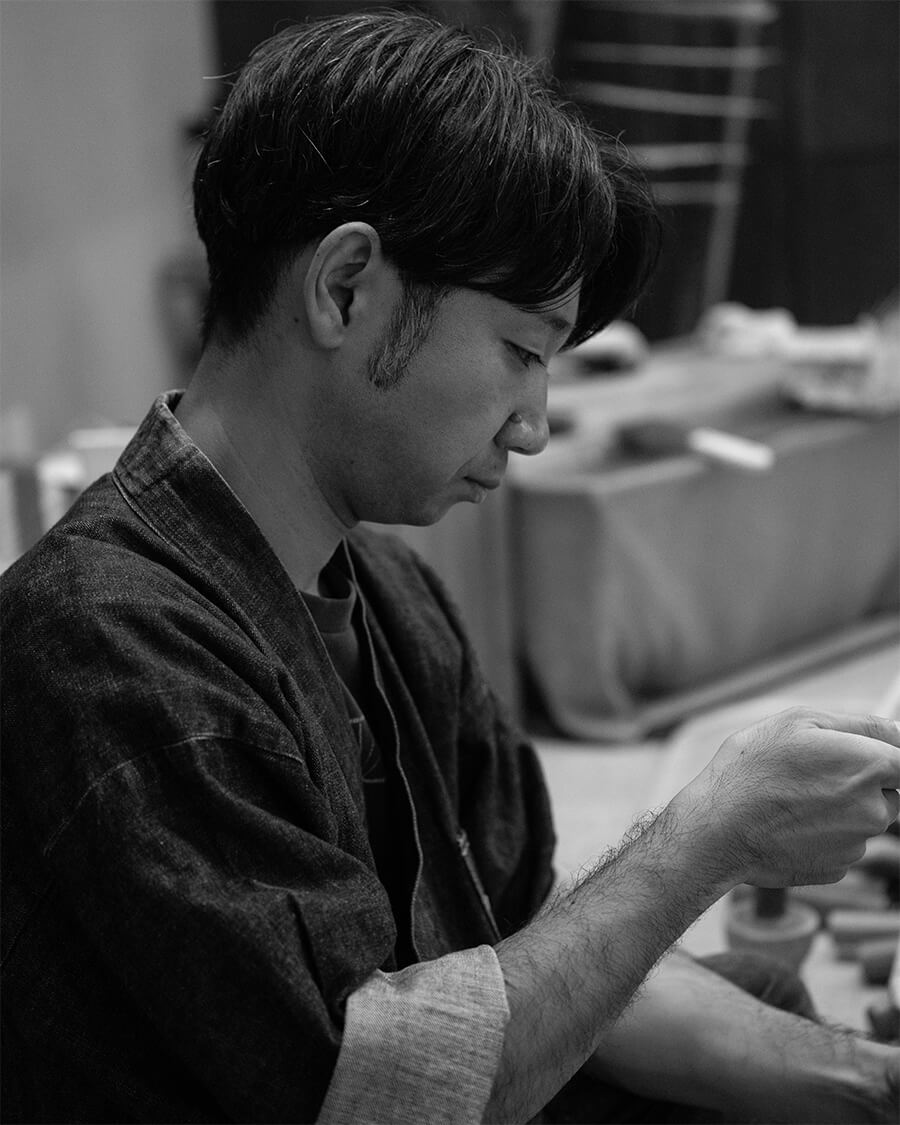
Kyohei Kurikawa, the fifth-generation owner
Visiting the Workshop
How KUTAMI SHIBU UCHIWA are made
At KURIKAWA SHOTEN, the making of KUTAMI SHIBU UCHIWA follows five main steps: splitting the bamboo, applying the paper, cutting the shape, reinforcing the frame, and finishing with persimmon tannin coating.
Around 10 artisans currently work at the workshop, with each process handled by a dedicated craftsperson under a fully specialized division of labor.
In addition, KURIKAWA SHOTEN operates a non-profit organization called “Denshojuku,” which supports the independence of people with physical or mental disabilities in Yamaga and surrounding areas by training them in traditional uchiwa-making techniques.
Beyond fan production, the workshop engages in a wide range of activities including printing services for calendars, business cards, and towels, wholesale distribution of daily goods, and hosting hands-on uchiwa-making workshops. With this multifaceted approach, the workshop produces and sells approximately 100 to 200 uchiwa per day―about 30,000 units annually.
This time, COVERCHORD visited the workshop to observe the full production process behind KUTAMI SHIBU UCHIWA.
BAMBOO SPLITTING
This step involves crafting the base structure of the uchiwa.
Madake bamboo, primarily sourced from the Aso mountain range and aged three years with a diameter of at least 7 sun (approx. 21 cm), is soaked in water for 2–3 days to soften it for processing.
The bamboo is then split into thin strips, and the ends are further shredded and spread into a radial fan shape.


Using a traditional splitting tool (wakiki) and a hatchet (nata),
the tips of the bamboo strips are further divided into finer strands.
Each strip is shaved down to a thickness of just 0.4–0.5mm.
The artisan then twists the bamboo by hand to loosen the fibers and spread them into a radial pattern.


Drilling side holes, inserting the bamboo stick, polishing the handle,
weaving with thread―finally completing the frame.
Thorough sun drying before moving to the next step.
PASTING
Attaching washi paper to the bamboo frame.
While locally made paper was used in the past, today a mix of papers is used, primarily handmade Yame washi from Fukuoka.
The paper is applied to both sides of the frame using denpun glue, carefully aligning the direction of the fibers.


TRIMMING
Cutting away the excess washi and bamboo frame.
Using a special trimming knife (narikiri bōchō) and a mallet, the shape of the uchiwa is cleanly defined in an instant.


The mallet inherited by Kyohei from his senior artisan.
Each craftsman has a distinct striking style,
with the upper dents made by his senior and the lower ones by Kyohei himself.
REINFORCEMENT
Since the cut edges from the trimming process are prone to tearing, narrow strips of washi are applied to the rim and base of the uchiwa.
This step is also known as “heri-tori” (edging).

SHIBU-NURI (Persimmon Tannin Coating)
The final step―and the most distinctive feature―of KUTAMI SHIBU UCHIWA.
Applying kakishibu (fermented persimmon tannin) adds insect-repelling, anti-mold, and waterproof qualities, resulting in a durable and long-lasting uchiwa.
At KURIKAWA SHOTEN, only homemade kakishibu is used―made from unripe gara-gaki (date plum) harvested in Yamaga and aged for over three years.


The preparation takes place in early August each year,
with the extracted raw tannin naturally fermented and aged.
This process gives rise to KUTAMI SHIBU UCHIWA
that grows richer in character the more it is used.


The fermented persimmon tannin is quickly a
nd evenly applied, then dried in the shade to finish.


KUTAMI SHIBU UCHIWA
BY KURIKAWA SHOTEN

PATTERNED BUSSEN
Price_¥1,500
Size_L 30cm W 14.5cm

PLAIN BUSSEN
Price_¥1,200
Size_L 30cm W 14.5cm

PLAIN SENSEN
Price_¥2,500
Size_L 37cm W 25cm

PLAIN SHOUMARU
Price_¥1,700
Size_L 38cm W 19cm

PLAIN KOBAN
Price_¥2,500
Size_L 37.5cm W 18cm


